

Today, we have access to more information than ever before. Advances in veterinary medicine and genetic testing have given us powerful tools to better understand the health of our breeds. As breeders, owners, and potential puppy homes, we can search online databases and forums, review generations of health testing and surveys, and compare statistics across breeds with just a few clicks.
The biggest challenge is no longer finding information – it is understanding the context in which that information exists. Data, by itself, does not constitute knowledge. To make thoughtful decisions, we must look deeper.
Elbow dysplasia in the Drentsche Patrijshond is a prime example. When we examine how elbow screening has evolved, how the data has changed over time, and what we know about the genetics of elbow dysplasia, a much more nuanced – and encouraging – picture emerges than what may appear at the surface.
The History of Elbow Screening
While the concept of elbow dysplasia screening in dogs has been around for some time, routine elbow screening in Drents is a relatively recent development.
It wasn’t until roughly a decade ago – shortly after 2014 – that elbow dysplasia screening became a breeding requirement under the Vereniging De Drentsche Patrijshond (VDPH), the largest Drent breed club in Europe. Prior to that, relatively few Drents were screened.
This timing matters.
Whenever a new health screening technology or requirement is introduced, breeders begin looking for conditions that were previously going undetected. As more dogs are tested, more affected dogs are identified – not necessarily because the disease has become more common, but because it is finally being measured.
The Preservation Breeder’s Balancing Act
Preservation breeding is rarely as simple as eliminating every dog with every undesirable trait.
As scientific advancements are made, every additional health test allows us to identify and track more conditions within the population. That is a tremendous advantage for responsible breeders looking to preserve or improve health – but it also creates difficult decisions.
If every dog with every identified issue is immediately removed from the breeding population, the available gene pool shrinks. Especially in a numerically small breed, like the Drentsche Patrijshond, this can increase inbreeding and reduce genetic diversity, potentially increasing the incidence of other complex diseases for which no genetic tests yet exist, while also contributing to the broader effects of inbreeding depression.
As Dr Pieter Oliehoek states in his 2023 Population Analysis Report for the Drentsche Patrijshond:
“(Unwanted genetic dispositions) arise from the loss of genetic diversity, which instigates inbreeding and consequentially breed-specific diseases that are undesirable to all. This situation is set to deteriorate if selection intensity increases, even when the selection is health-focused.”
The goal of preservation breeding is not simply to eliminate disease at all costs. It is to improve the overall health of the population while maintaining enough genetic diversity for future generations, as well as the temperament, working ability, and look that make the breed what it is beloved for.
What the OFA Data Actually Shows
Looking only at the overall Orthopedic Foundation for Animals (OFA) statistics, Drents appear to have a higher total rate of elbow dysplasia (20%) than breeds such as German Shorthaired Pointers (1.5%), German Wirehaired Pointer (3%), or the Stabyhoun (13%).
However, looking at the data by birth year tells a much more encouraging story.
Initially, very few Drents were screened, worldwide or in North America. As elbow screening became more common, the reported incidence of elbow dysplasia increased sharply. This likely reflects increased detection rather than a sudden increase in disease.
The prevalence appears to peak (32% abnormal/dysplastic) among dogs born between approximately 2011 and 2015. After that, the trend began a steady decline, coinciding with the period when elbow screening became commonplace, and breeders began incorporating those results into breeding decisions.
For dogs born in 2021 and later, the OFA database currently shows a passing rate of approximately 94%. This is a 25% difference in only a handful of generations – an astounding improvement.
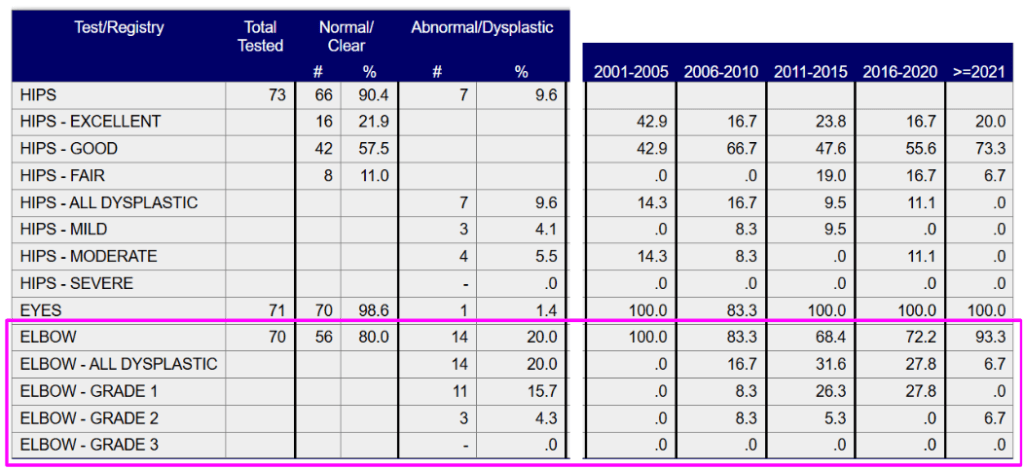
Importantly, this improvement has occurred through thoughtful selection. Not necessarily by eliminating every non-passing dog from breeding, but by making careful breeding decisions across the population, including strategic pairings where appropriate.
Age at Screening Matters
Another interesting observation comes from reviewing the publicly available OFA records for dogs with elbow dysplasia (9 of the 14 noted in the testing statistics above).
Approximately one-third of those dogs were already five or six years of age—or older—when they were evaluated. In many cases, these were individuals identified as potential stud dogs by breeders doggedly searching for opportunities to utilize as much genetic diversity available on domestic soil as possible, rather than dogs who were selected and raised as breeding prospects from puppyhood.
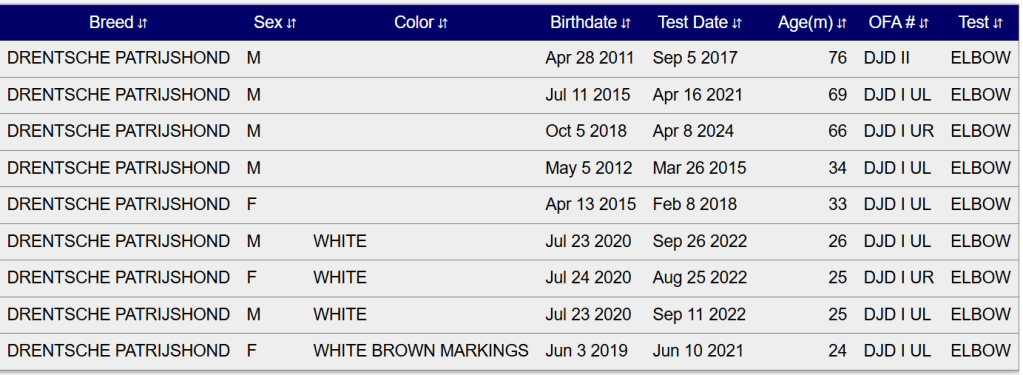
As dogs age, accidents, injuries, and normal wear and tear can all contribute to degenerative changes within joints. While these dogs may certainly have had a genetic predisposition to elbow dysplasia, we cannot know how much of their final radiographic findings were influenced by genetics versus injury or age-related degeneration.
Compared with several similar sporting breeds, Drents appear to have a relatively large proportion of middle-aged and senior dogs among non-passing elbow results at the time of screening. This may contribute, at least in part, to the breed’s overall reported prevalence.
Elbow Dysplasia Is Not Inherited Like a Simple Genetic Disease
Looking further into the publicly available OFA records provides another important observation.
Among dogs with publicly available non-passing elbow results whose parents are also listed (4 of the 9 listed animals), none have parents who are themselves recorded as having elbow dysplasia.
(You can verify this yourself by doing the same Advanced Search as above, then clicking in to view each dog. If they have a sire and/or dam recorded in the OFA database, you can click to view their results as well)
Likewise, regarding the one dog listed with elbow dysplasia who also has tested offspring, all three offspring have passing elbow certifications, and a fourth has passed preliminary evaluation.
This is certainly not the complete picture. OFA allows owners to keep non-passing results private, meaning we cannot see every affected dog.
Nevertheless, these examples illustrate an important biological reality: elbow dysplasia is a complex polygenic disease also influenced by environmental factors.
Passing dogs can produce dysplastic offspring.
Dysplastic dogs can produce passing offspring.
There are no guarantees.
Understanding Risk Versus Certainty
OFA data across all breeds demonstrates that breeding decisions do influence risk.
Breeding between two normal dogs produces offspring with elbow dysplasia at a rate of approximately 10%.
When one parent has Grade 1 elbow dysplasia and the other is normal, that risk increases to roughly 22–24%.
That increased risk is real and should not be dismissed.
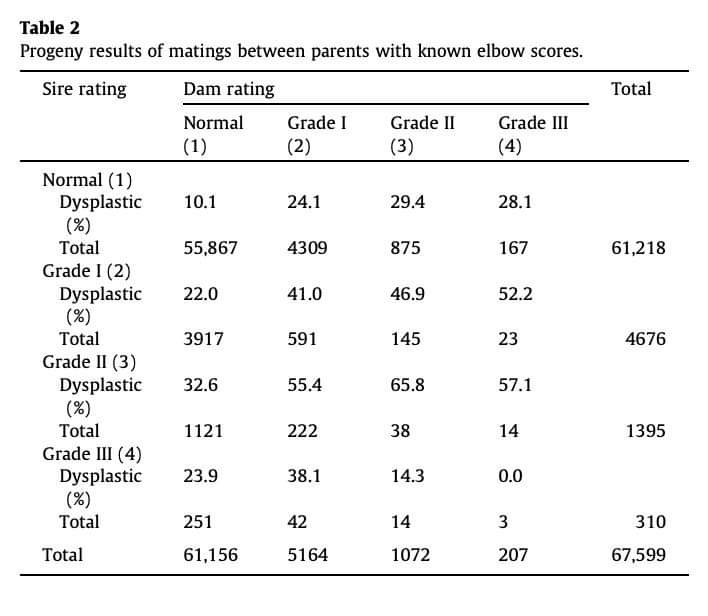
However, it is also helpful to consider these numbers alongside comparable data for hip dysplasia. According to OFA statistics, a breeding between two dogs with Fair hips (still considered passing and acceptable by most breeding standards) also carries roughly a 20% chance of producing offspring with failing hip scores.
In other words, the level of risk accepted for hips is remarkably similar to the risk associated with breeding a Grade 1 elbow dysplastic dog to a normal dog, though the latter is often viewed much more critically.
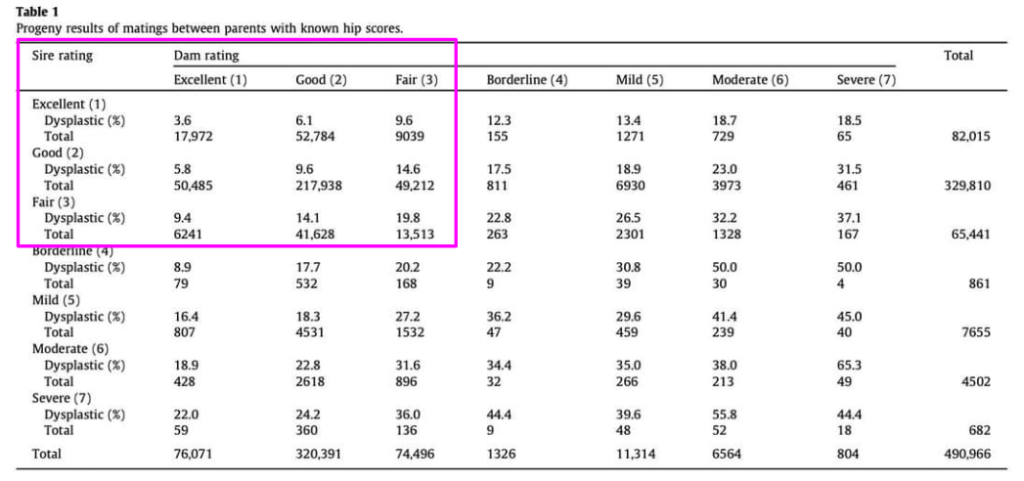
This does not mean the two conditions are identical, nor does it mean every breeding involving a dog with elbow dysplasia is appropriate. Rather, it highlights that breeding decisions and associated risk factors should be evaluated in the context of the entire dog, the pedigree, and the overall breeding program, rather than the result of a single evaluation measure.
Every breeder—and every puppy buyer—has the right to determine their own level of acceptable risk.
Responsible breeders should be transparent about the health information behind their breeding decisions, allowing puppy buyers to make informed choices. Likewise, no breeder should feel obligated to use a dog with a non-passing elbow score if doing so conflicts with the goals or philosophy of their breeding program.
At the same time, it is important to understand the whole picture when determining if the risks (and there are always risks) of a pairing are outweighed by the benefits, such as exceptional temperament, structure, working ability, longevity, or valuable genetic diversity that is difficult—or impossible—to replace.
Learning From the Past
Within the Drent community, many longtime breeders have shared stories from the early 2000s, when screening for progressive retinal atrophy (PRA) became widespread.
The rapid removal of affected dogs from breeding is often cited as having coincided with an increase in the occurrence of epilepsy within the breed.
Whether this relationship was directly causal is impossible to prove retrospectively. However, the story illustrates an important principle of population genetics: aggressively removing animals from a small breeding population can have unintended consequences, even if the selection is based on health measures.
We are fortunate compared to many other sporting breeds that cancer is not a widespread concern in Drents. We are also fortunate that epilepsy cases are exceedingly rare in North America. While we can and should continue to improve health across all measures, it will behoove the population to take a strategic and cautious approach rather than a hard cutover that can’t be undone.
Looking Forward
The encouraging news is that the incidence of elbow dysplasia appears to be improving within the Drentsche Patrijshond population, and rapidly so.
The available data suggests that increased screening, thoughtful breeding decisions, and continued transparency are already producing measurable progress, even without eliminating all dogs with abnormal results from the breeding population.
For a rare breed, preservation breeding requires balancing many competing priorities simultaneously: orthopedic health, genetic diversity, temperament, working ability, longevity, and countless other traits.
Instead of treating elbow dysplasia as a simple black-and-white issue, or sensationalizing the data to provoke unnecessary fear, I believe we should continue monitoring the trends over time, encouraging widespread health testing, supporting breeder diversity and transparency, educating potential puppy homes, and making thoughtful breeding decisions that strengthen our breed as a whole—not just one health statistic at a time.


Leave a Reply