
The Drentsche Patrijshond
The Drentsche Patrijshond, also called the Dutch Partridge Dog or Drent, is a rare versatile pointing breed originating from the Netherlands. The Drent is a landrace breed over 400 years old, and was formally recognized by the Raad van Beheer op Kynologisch Gebied (Dutch Kennel Club) on May 15, 1943, and added to the American Kennel Club Foundation Stock Service in 2010.
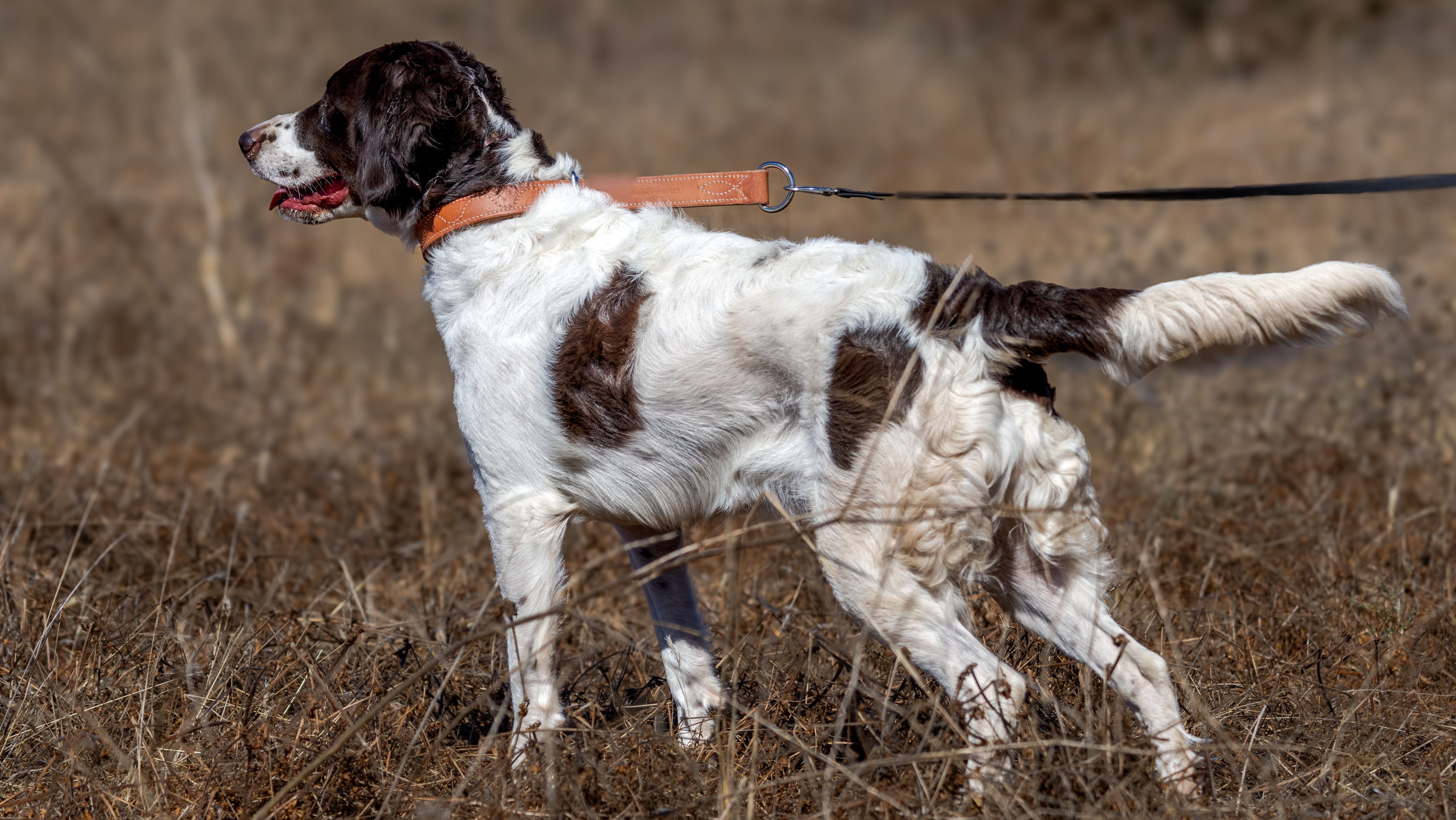
The Drent is a versatile, active, intelligent, cooperative, and joyful breed. Depending on the individual dog, a Drent could be an excellent fit for an active family, an upland foot hunter/occasional waterfowl hunter, and/or as a show or performance sport dog.
There are an estimated 150 Drents living in North America and less than 3500 worldwide, concentrated mostly in their homeland of the Netherlands, with pockets also in Germany, Belgium, Sweden, Norway, and Denmark. Unfortunately, the population worldwide has been declining in recent decades, down from a peak of 6000 dogs circa 2010. While the breed is seeing the beginnings of a resurgence, especially in North America, it remains very much in need of dedicated owners and breeders committed to the preservation of these special dogs.

History
The breed was founded on three pillars: hunting, watch dog, and companion (or field, farm, and family). It originated in the 16th century from the early Spioenen dogs which came to the Netherlands via France from Spain. Especially in the province of Drenthe, from which the Drent gets its name, these dogs were kept purebred. The Drent is most closely related to the French Spaniel and Small Munsterlander. Despite a loosely similar appearance, the Drent is not closely related to the German Longhaired Pointer/Deutsch Langhaar, Large Munsterlander, Brittany, English Springer Spaniel, or any of the Setter breeds.
Drenthe was unusual at the time of the Drent’s early development, in that it was one of the very few places where the common folk were allowed to hunt. However, the average commoner could not afford highly specialized dogs for various purposes like the rich and royal could, and therefore they required a versatile, all-purpose dog. The Drent was developed not through a rigorously controlled breeding program as many versatile German hunting breeds were, but naturally as a product of what the local culture needed and desired in a dog. The Drent was used to hunt feather and fur, alert to the arrival of visitors on the property, and serve as a playmate and companion for the children.
While the breed itself is thought to be over 400 years old, it wasn’t until rising feelings of nationalism following WWII fueled an effort that resulted in the Drent being formally recognized by the Raad van Beheer op Kynologisch Gebied (Dutch Kennel Club) on May 15, 1943. On June 5th, 1948, the original Dutch breed club was founded: the Vereniging de Drentsche Patrijshond.
Drents started to gain footing in North America in the early 2000’s and were added to the American Kennel Club Foundation Stock Service in 2010 where they remain today. The first North American breed club was founded in 2008, and more recently, the American Drentsche Patrijshond Association was founded in 2024. There is also a second Dutch club, Swedish club, Belgian club, and Danish club.
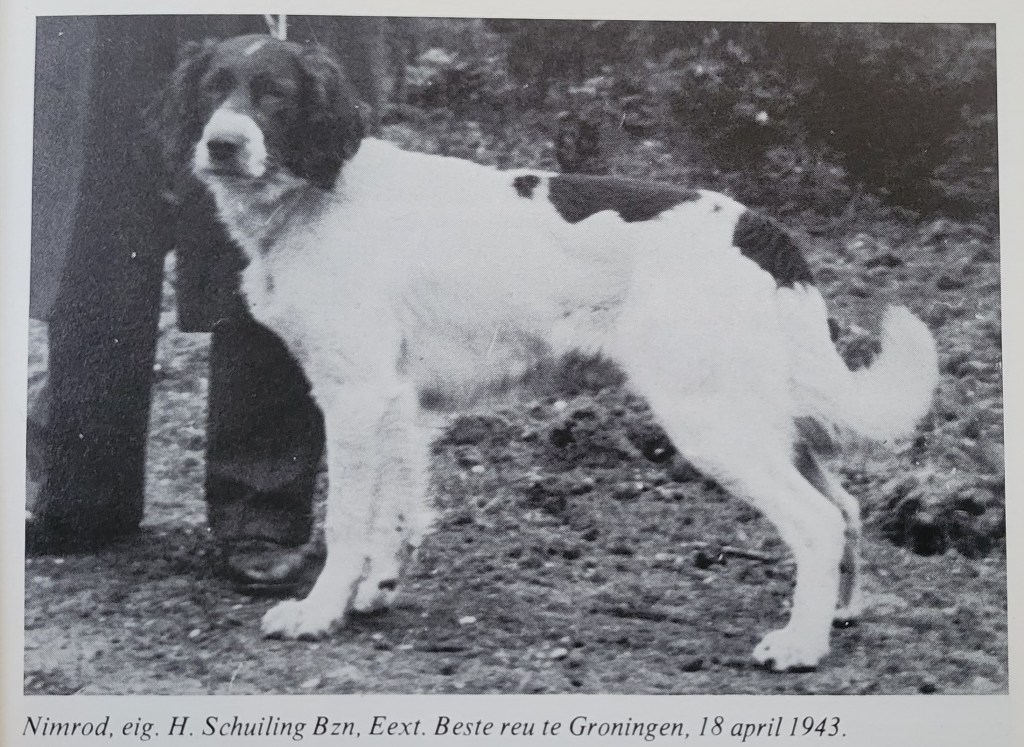
Shown at right is Nimrod, the male winner of the first Drent breed show and after whom the Breed Standard was written.
Basic Info
Height: 21.5-23.5″ (females); 23-25″ (males)
Weight: 50-65lbs (females); 60-75lbs (males)
Life Expectancy: 11-14 years
Drentsche Patrijshond is pronounced “dren-suh pa’trize-hond” (click here for a Dutch speaker’s pronunciation!). The proper plural form is Drentsche Patrijshonden. “Drent”/”Drents” is accepted both in Dutch and English as a short version of the name; you may also see the name shortened to Drentsche Patrijs, or spelled without the “ch”, “Drentse”. While “Dutch Partridge Dog” is also sometimes used, it’s not an entirely accurate translation. “Drentsche” means specifically from the Province of Drenthe, and the Drent was and is used on many other birds beyond Partridge!

In terms of size, due to their more substantial bone/muscle than otherwise similar sporting breeds, Drents can be considered either a large medium-sized breed or a small large breed. Drents should be athletic, powerful, and capable of achieving the necessary speed of a gun dog; and neither heavy nor racy in appearance.
Shown at left, Ch. Boaz Hesther v. Groevenbeek, a male Drent born in 1995. Photo from the book De Drentsche Patrijshond by Janny Offereins-Snoek.
Temperament
There is something special about a Drent’s temperament that can be hard to put your finger on until you meet one. Many folks, upon meeting a Drent for the first time, have been known to quickly catch the “Drent Virus” and fall in love. I believe it has to do with the balance between their intelligence, intuitiveness, and beauty, with their playfulness, joyfulness, and quirkiness. They aren’t extreme in any one way, and while that makes it hard for them to “stand out” on the internet, it’s hard to ignore the feeling they give you in person. They really are the whole package!
The Drent is a generally friendly dog who should show no aggression towards other dogs (of either sex) or people. The Drent was used as a property watch dog for much of its history, so they are often noticeably aware of their environment and may alert bark, particularly to strangers approaching the home, but it is easy to join a Drent’s circle of trust with a proper introduction (treats are a bonus!). That said, a Drent will typically bond most closely to their immediate family. They are affectionate without being overly clingy nor prone to separation anxiety, and love to “help” and generally be involved with whatever you are doing. Drents are well-known to be excellent with children. Drents can live with cats and/or among farm animals if raised with them, but they are a breed with prey drive, so care should be kept to ensure the dog understands boundaries with other small animals in the home.

Drents are happy, playful, silly dogs who are a joy to have around. They are notoriously slow to mature, and will often seem “behind” other puppies of the same age in terms of physical, mental, and emotional maturity, particularly for the first 18 months, but up until 2 or 3 years old, with males maturing more slowly than females. But with patience and a sense of humor, you will be rewarded with a companion like no other when a Drent reaches its prime.
Shown at left, Iris at 4 years old and her cousin, Fern, 1 year old.
Energy & Drives
Drents can range from medium to medium-high energy, and thrive when provided opportunities for both physical and mental exercise. They have enough “go” for just about anything you want to do, including long days in the field, in the ring, or at the trial site. Don’t expect a Drent to be a couch ornament, but given regular outlets for their body and brain, a mature Drent should be able to turn all the way off in the home and manage a few “off days” when necessary without becoming a nuisance.
While every family, situation, and dog will be different, expect to spend dedicated time each day with your Drent. They will do best when kept in the home and included in most of your every day activities.
For most Drents, their highest level reward, drive, or distraction (depending on your perspective) will be upland game birds. Most have medium-high food drive, and medium to medium-high play drive – plenty enough to train with, without extremes.

Use & Training
Drents are categorized as a versatile pointing breed (or HPR – hunt, point, retrieve), and have historically been used on both upland game and waterfowl, small furred game, and in some areas, the blood tracking of large downed game. That said, they do not typically have the same level of “sharpness” as many German breeds do on fur, and also will not suffer the same level of pressure in field training that many German breeds can tolerate. Craig Koshyk has a fantastic article comparing Drive vs Desire in German vs French breeds; the Drent (a Dutch breed) seems to fall more in line with his description of the French breeds and how they work moreso out of a Desire to do so.
A Drent will thrive when trained with primarily rewards-based methods and a cooperative partnership with their owner/handler. They are a “work with you, not for you” breed, and while they do WANT to work with you, a handler with a heavy hand or who is unfair and/or inconsistent in their asks may end up frustrated with a Drent that knows their worth and will not suffer unjust treatment.
As there is not a large split in the breed, most Drents can do reasonably well in show, sports, and the field. In terms of sport, due to their nature as a hunting dog, Drents are likely to excel most in Pointing and/or Retrieving Hunt Tests, or scent-based sports like Scent Work and Tracking, but have also had success in many venues such as Rally, Obedience, Tricks, Canicross, Dock Diving, Barn Hunt, FastCAT, Coursing, Joring, Agility, and more. In recent years the breed has started to gain popularity among performance sport enthusiasts, especially those who are interested in doing a “little bit of everything”, so we are learning a ton about where the breed does well and how to approach training better for the future.
Note on Drents as Service Dogs: I personally do not recommend Drents as public access and/or mobility service dogs, due primarily to their innate awareness of their environment (from their history as a pointing breed and property alert dog) and their “work with you, not for you” temperament. While they would certainly be capable intelligence-wise, especially in the realm of medical alert/detection, there are many other breeds more consistently suitable. At Meliora Drents, we do not place puppies for service dog work.
Health
The Drent is fortunately a healthy, resilient breed, with average lifespan into the early-mid teens. Despite global concerns around genetic diversity and a declining gene pool, the breed thankfully does not yet suffer from cancers to the extent of other modern sporting breeds. While most of these things remain uncommon, breed-relevant things to look out for include epilepsy, hip and elbow dysplasia, mild allergies, and mild dentition/bite abnormalities. PRA used to exist in the breed but has largely disappeared from the population in recent generations.
In Drents, some genetic risk markers such as those for von Willebrand Disease Type 1 (vWD1), Degenerative Myelopathy (DM), and Hyperuricosuria (HUU) occasionally appear on genetic testing reports from companies like Embark Vet. However, there have been few, if any, reports of these diseases actually occurring in Drents. More data and studies are needed to determine the relevance of these risk markers to the breed population; given current knowledge, the actual risk is considered low to none by most. None of the European breed clubs require genetic testing for these diseases, nor does the ADPA.
Responsible Drent breeders should be screening breeding dogs for hip and elbow dysplasia, and perform at least one eye exam at maturity. They should also be doing their due diligence in evaluating their breeding dogs and pedigrees to reduce incidence of epilepsy. Thankfully, epilepsy has been largely kept out of the North American breeding population.
Coat, Colors, & Grooming
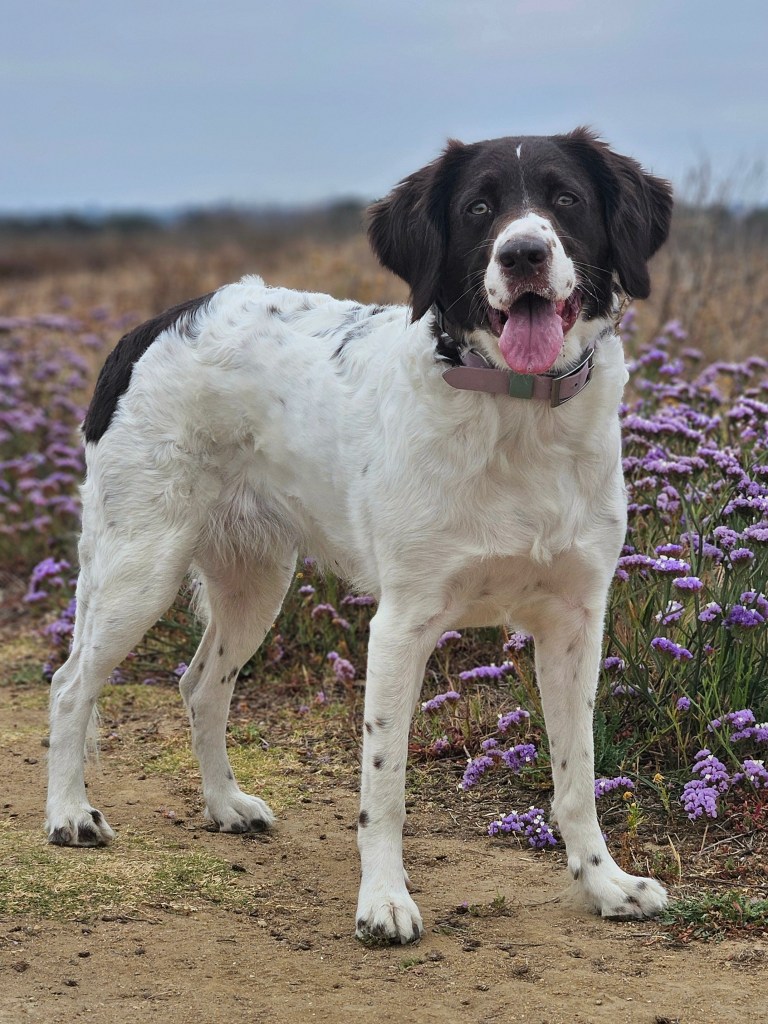
Drents come only in white with brown plates, but that brown can range in hue from nearly orange auburn/milk chocolate to a near-black dark chocolate brown. True black or tricolor is a severe fault. Ideally, a Drent should be at least 50% white, with brown around both eyes, completely brown ears, and (historically) a brown plate at the base of the tail. A large mantle or saddle of brown is undesirable. Small spots or “spikkels” of brown are common, especially on the nose and legs, and is not typically faulted if it’s not excessive, but generally a “cleaner” white is more desirable. Roaning (a mixture or brown and white hairs) is strongly undesirable in direct correlation with how widespread it is on the dog. Heads may be solid brown, or have a white muzzle and/or blaze, as long as no white touches the eyes or ears.
Drents have a medium-length coat with longer furnishings on the chest and back of the legs. Males typically have a longer and thicker coat than females. A correct coat has a wavy, not curly, texture, and is soft and not-oily to the touch. While they are not built to hold up in cold water like a labrador, the breed is tolerant of a range of temperatures and can adapt to their environment.

Grooming needs are minimal. They are medium shedders, with light hair that will float around your home but is easy to sweep/vacuum. Because their coats are non-oily, when they dry, dirt and debris is easy to brush out and they do not need frequent baths. A weekly brush and nail trim should be the minimum grooming needs for a Drent, with the addition of stripping dead/sun-bleached hairs to shape the ears and trimming the hair between the toes being all that’s needed to get them show ring ready. A spayed/neutered Drent may need more frequent grooming depending on the lines.
Shown above is Iris, a 2 year old female. Without the two plates on her body, Iris would be considered a “minimally marked” Drent.
Compared To….
These are high-level generalizations, reflecting my experience speaking with people who have or are considering these breeds and wondering what the differences are – take with a grain of salt!
Golden Retriever: Drents are less forwardly outgoing with strangers. Also, Drents being pointers and not retrievers, are not typically as water-obsessed and bit more independent thinkers and less classically “biddable”.
English Springer Spaniel: Similar temperament comparison to Goldens. Drents are not spaniels (flushers) and are typically larger than ESS’s. Drents do not have as defined of a show/field split and are not typically as “busy”.
Brittany: Drents are larger, only come in brown & white, and are slightly rectangular in body rather than square. Drents have a closer running range but are less prone to separation anxiety.
German Shorthaired Pointer: Drents have a much closer running range, and will not suffer the same level of pressure in training that a typical GSP might. Drents are typically less high-strung and settle easier in the home.
Small Munsterlander: Drents are less intense in the field, will settle easier in the home, and will not suffer the same level of pressure in training. Drents are slightly larger in size. Quality SMs are typically also only sold to hunting homes, while Drent breeders are more open to selling to active non-hunting homes.
How Do I Get One?

We are proud member-breeders of the ADPA! In the US and Canada, the overwhelming majority of active and prospective breeders are associated with the American Drentsche Patrijshond Association. Check out the ADPA’s member-breeder list or litter announcement page for details.
With the current CDC regulations requiring imported puppies to be at least 6 months old to come into the US, importing is very challenging without an established relationship with a European breeder. Your best bet may be to work with folks already established in the breed in the US to help identify options.
For further information, please feel free to peruse our blog or reach out!
 Meliora Drents