

NOTE: These two sections were originally an article submitted to the ADPA Newsletter, published December 2024, and a social media post made in June 2025. The content has been combined and refined for cohesion here.
As always, the opinions stated herein are mine, and are not to be taken as a statement on behalf of the ADPA as a whole.
AKC Recognition: The Why & The How (December 2024)
One of the ADPA’s founding pillars is to pursue American Kennel Club Parent Club recognition of the ADPA and Miscellaneous Class recognition of the breed, capitalizing on the visibility and ubiquity of the AKC in America to benefit the breed’s development. But what, exactly, does that mean, why is this a goal, and how do we get there?
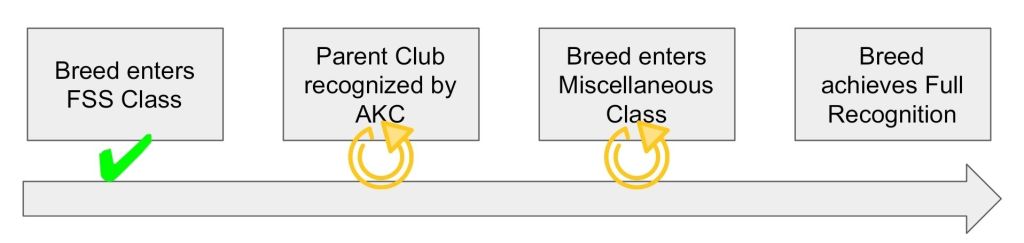
The Drentsche Patrijshond entered the AKC Foundation Stock Service (FSS) in 2010 and remains there today. FSS is a service that AKC offers to rare breeds and breeds in development in the United States. Breeds accepted into the FSS program can have pedigrees maintained by the AKC and compete in the many companion and performance events/sports offered by the AKC, excluding certain things like All-Breed conformation shows and Field Trials. FSS breeds can, however, participate in Open Shows – a specific type of conformation show exclusive to breeds in the FSS and Miscellaneous classes. Open Shows aren’t as common and have a different point and titling system than AKC’s regular All-Breed shows.
An FSS breed must meet certain requirements outlined by the AKC before advancing to the Miscellaneous Class (a “next step” on the road to recognition), and then additional requirements before moving on to Full Recognition.
When a breed is on the precipice of advancing to the Miscellaneous Class, a Parent Club is recognized by the AKC as the breed’s “governing body”. The role of a Parent Club is to maintain the written breed standard which describes the form and function of the breed; educate owners, breeders, judges, and the public about their breed; and participate in initiatives to protect, preserve, and advance the breed, such as research into health conditions relevant for the breed and facilitating breed-specific rescue.
Why (& Why Not) AKC Recognition?
The benefits of further recognition of the ADPA and the Drent by the AKC include:
- Increasing the visibility of the breed, drawing more enthusiastic owners, handlers, and breeders into the community.
- Increasing the availability of conformation show opportunities (by allowing participation in All-Breed shows) and the opportunity to compete in Field Trials.
- Providing the ADPA (if recognized as the breed Parent Club) the authority to manage the Drentsche Patrijshond Breed Standard and provide Judge’s Education (ensuring that judges are more likely to reward dogs whose conformation supports their function as a hunting dog).
- Increase the credibility of the ADPA as a steward for the breed in America, allowing the ADPA to better collaborate with research institutions such as the Orthopedic Foundation for Animals, and collaborate with international Drent clubs, to protect, preserve, and advance the Drent.
There are also potential drawbacks of recognition by the AKC, especially if the pursuit of it is not done sustainably and thoughtfully, including:
- Increased visibility of the breed draws more unscrupulous individuals and breeders who wish to capitalize on the selling of a “rare breed”, in order to meet an increased demand for puppies that responsible breeders might not be able to.
- If the domestic population isn’t large enough at Full Recognition, it will be challenging to obtain the “majors” needed for a traditional AKC conformation Championship title, which require a certain number of Drents present at each show.
- Too much focus on winning conformation shows could result in a detriment of the Drent’s other capabilities as a field, farm, and family dog.
The ADPA can mitigate these potential drawbacks by following our other three founding pillars: creating, collecting, and distributing educational resources to maintain good breeding best practices (Education); supporting both new and long-time breeders to thoughtfully grow the population before rushing to full recognition (Population); and sustainably building a community of people who enthusiastically love the Drent for its many talents and wish to maintain the breed accordingly (Community).
However, what I believe will benefit the breed the most is not necessarily AKC recognition itself, but in the pursuit of that goal, all the things the breed community will need to do along the way – namely, getting their dogs out into show rings and trial fields and other public events. These opportunities allow us to grow our bonds with our dogs, give them venues to reach their full potential, and teach us more and more about what this amazing breed is capable of. They also introduce the breed to potential new fanciers who will help the population grow and advance to a more sustainable level while, hopefully, also maintaining its unique and historic traits as a field, farm, and family dog – so that we may all cherish the Drentsche Patrijshond breed for generations to come.
AKC Recognition: A Milestone, Not a Goal (June 2025)
It is my opinion that AKC Recognition should not be the goal, but a natural outcome along the way for the growth & preservation of a rare breed.
It’s not uncommon for folks involved in FSS breeds to make AKC recognition their holy grail, and that seems strange to me. Besides some additional showing opportunities and increased visibility of the breed in the US, full AKC recognition doesn’t really offer much. And when you have a small-population rare breed that has only a handful of dogs showing and only a handful of breeders producing puppies, what’s the point of those two benefits, anyway?
There is a very understandable desire among folks who are passionate about their breed to see them recognized on the same plane as more common breeds. There can be a weird attitude from other purebred enthusiasts that breeds that aren’t recognized are somehow “less than” those that are, or that more breeds achieving full recognition is somehow detrimental to those who have long been. And that can be understandably frustrating to those of us who have breeds that, while rare, often have long and storied histories, and wonderful qualities that make them worth stewarding into the future.
But by rushing to full recognition before a breed is ready, are we not in some way proving these naysayers right? If a breed achieves full recognition but then is rarely if ever seen at all-breed shows or other events, and when they are, the consistency & quality of dogs isn’t there, is the mantle of “full recognition” really meaningful at all?
It’s no secret that I’m an advocate for the Drentsche Patrijshond eventually achieving full recognition with AKC. But for me, I want to see a thriving, sustainable community built on passion for the breed, not one laser-focused on the AKC goalpost. When that milestone is passed, I want it to be just that, a milestone, not the end-goal.
I want Drent owners showing their dogs in conformation & sports & tests & events because they love doing it with these talented dogs, not because we need a certain amount of competitors for AKC to recognize the breed. I want breeders who are growing the breed population thoughtfully, sustainably, and collaboratively with the goal of preservation, not to meet a certain number of registrations for AKC’s benefit. I want a community of owners – exhibitors, breeders, and those with “just pets” – that is thriving and enjoyable and supportive of all levels of involvement in the breed, not just a clique of those who are involved in “AKC stuff” running the show.
I don’t want Drents to be the next Golden Retriever or Lab or Frenchie. I want them to be Drents, preserved for their uniqueness and history, thriving and sustainable into the future. If we achieve AKC recognition along the way? Awesome. But that’ll just be a bonus.
I encourage other folks involved in FSS breeds to consider – what’s the rush towards recognition? What does full AKC recognition offer your breed, truly? When your breed achieves full recognition, will they have the numbers and the quality to take advantage of the benefits of participating at all-breed shows? Do you have enough responsible breeders to meet a potentially increased demand for puppies? Most importantly, do you have a broad enough base to sustain your breed not just through recognition, but generations into the future?

 Meliora Drents
Leave a comment