
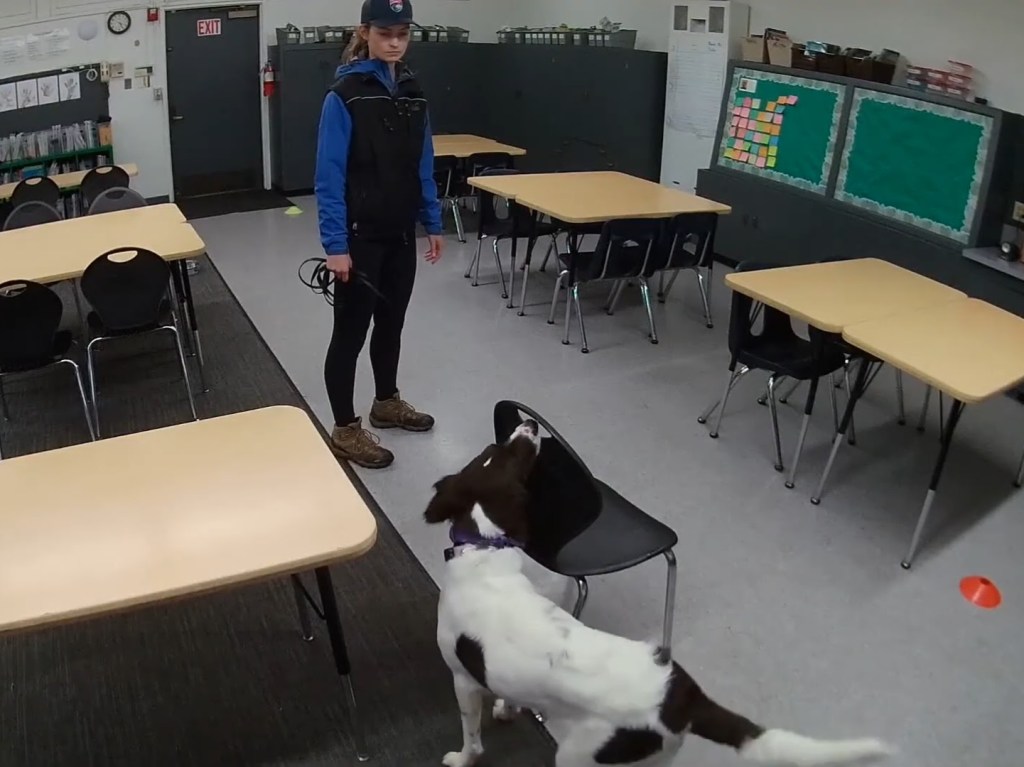
Handling a dog in scentwork is an exercise in observation. Understanding the four behavior patterns – sniffing, searching, sourcing, and alerting (or indicating) – of a dog using their nose can help tremendously with understanding the nature of the search.
The 4 Behaviors
Sniffing is the regular behavior of most dogs most of the time outside of the context of scentwork. Think about how your dog looks when walking your neighborhood, or hanging out in the backyard. Usually, it’s a relaxed, slower, not particularly focused type of sniffing. It’s just how they interact with the world through their primary sense.
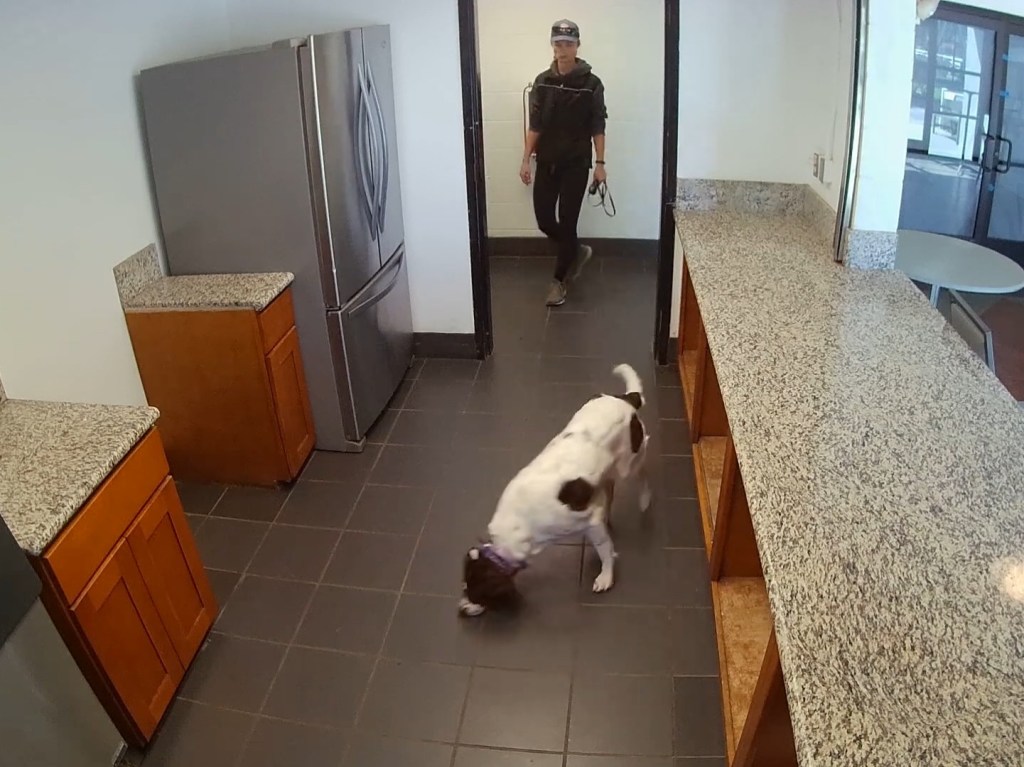
Searching, in contrast, is a focused behavior. The dog knows they are looking for a particular something. There’s purpose to the way they move and sniff. For Iris, this looks like moving at a smooth trot, head level with her spine, tail carried loose and slightly higher than level, mouth often open to take in more scent.
Sourcing is when the dog has found the scent cone but not yet the source. They can smell particles of what they are looking for, so they’ll usually slow down and start to sniff in a more “detailed” manner, trying to move towards higher and higher concentration of those particles until they find the source. For Iris, this looks like bracketing (moving side to side) around the scent cone to determine its direction, tail held a bit lower and softly wagging, mouth closed or ocassionally “chuffing” and audibly sniffing from her nose, with her nose either on the ground, up high in the air, or locked in on an object in the environment.
Alerting is the dog indicating they’ve found source. Obviously, you can train a specific alert, and that’s an easy way to notice this change of behavior. Iris’s primary alert is a nose freeze (which I taught), and secondarily, she will down or sit (which she offered and I reinforced). But even without those specific behaviors, I can tell when she’s at source by the faster tail wag and tippy tappy feet. And it’s good to know those things in case something about the environment makes the trained alert difficult – such as an inaccessible hide.
Note: Dogs with prey drive may also “critter” when they smell prey animals, which may look a lot like searching/sourcing. But most dogs will show subtle differences if they are in active prey drive versus in scentwork mode.
Examples – Iris




How to Use Them
Knowing the difference in your dog’s behavior between sniffing and searching is the best way to identify if they understand the task at hand and if they’re comfortable in the environment. A dog who is confused or nervous or uncomfortable may not search, but sniff instead. This is particularly important to keep an eye out for in a novice dog.
With an experienced dog, sniffing instead of searching can also be an indication of if the area you are currently in is “productive” or not. If Iris knows there isn’t any scent in an area, and I keep her in that area too long, she will shift down from searching to sniffing. Thats a huge cue to me that I need to guide her to move on or call “finish”.
The ability to distinguish sourcing behavior from searching and alerting is another way to manage a search area. In Iris’s first Excellent interior search, I saw her shift from searching to sourcing in one area, but she did not alert – she moved on to another area, where she sourced and alerted on a different hide. But I had made a mental note of that first sourcing behavior change, and guided her back to that first area. When she approached it from another direction, she was able to source again and this time find the hide itself and alert.
While ideally every time a dog sources, they actually find source and alert, sometimes they need to come back to it from another direction that’s more accessible. Or they might get “pushed” off the hide before by a distraction or pressure that the handler may or may not be aware of.
While my handling philosophy prioritizes independent, unguided searching, and therefore minimal obvious “handling”, I am constantly and feverishly taking mental notes based on behavior changes (or lack thereof) in the search area. And I will do subtle things like turn my body towards an area I want her to check or go back to. I’ll also ocassionally verbally call or direct her, but only if I am sure she’s not sourcing so as not to incidentally call her off a hide.
It’s a constant, non-verbal conversation between us, and when that conversation seems effortless? That’s the magic of scentwork.

 Meliora Drents
Leave a comment